Goal: Determine the effect on a function X(y) due to a change in parameter y. This is known as the sensitivity of X to y.
This is expressed:

Consider a form of usage in Mathematica. Let X be “func”; let y be “m”. The expression equivalency is:

To implement in Mathematica:
![\begin{displaymath}\begin{align}&\text{m = y;} \\&\text{func = X;} \\&\text{result} \; = \; \frac{\text{m}}{\, \text{func} \, } \, \text{D[func,m]}\end{align}\end{displaymath}](https://davemcglone.com/wp-content/ql-cache/quicklatex.com-37b7c3cb5746b723896c958bb3595f39_l3.png "Rendered by QuickLaTeX.com")
An example … (Note: “![\text{Log[ ]}](https://davemcglone.com/wp-content/ql-cache/quicklatex.com-55e9260f8c77c183009689c4a20a7fdd_l3.png "Rendered by QuickLaTeX.com") ” in Mathematica is the natural logarithm, aka “
” in Mathematica is the natural logarithm, aka “ “)
“)
First define the functions:
![\begin{displaymath}\begin{align}&\text{func1 = x } \mathbb{e}^{\text{-y z } \, (\alpha \, + \, \Delta \alpha) } \\\\&\text{func2 = PowerExpand[Log[func1]] } \rightarrow \, \text{- y z }(\alpha \, + \, \Delta \alpha) \, + \, \text{Log[x]}\end{align}\end{displaymath}](https://davemcglone.com/wp-content/ql-cache/quicklatex.com-5f6b1934171fd00298f07bf099acfc6c_l3.png "Rendered by QuickLaTeX.com")
Then define the expressions:
![\begin{displaymath}\text{s1 = }\frac{\Delta \alpha}{\, \text{func1} \, } \, \text{D[func1,} \, \Delta \alpha\text{] // Simplify} \; \; \rightarrow \; \; \text{-y z }\Delta \alpha\end{displaymath}](https://davemcglone.com/wp-content/ql-cache/quicklatex.com-ee7c6bbaf02900f0c996137a623593da_l3.png "Rendered by QuickLaTeX.com")
![\begin{displaymath}\text{s2 = }\frac{\Delta \alpha}{\, \text{func2} \, } \, \text{D[func2,} \, \Delta \alpha\text{] // Simplify} \; \; \rightarrow \; \; \frac{\text{y z }\Delta \alpha}{\, \text{y z }(\alpha \, + \Delta \alpha) \, - \, \text{Log[x]}\,}\end{displaymath}](https://davemcglone.com/wp-content/ql-cache/quicklatex.com-7959362287e24dd5999a9d693731868b_l3.png "Rendered by QuickLaTeX.com")
Consider a basic voltage divider.
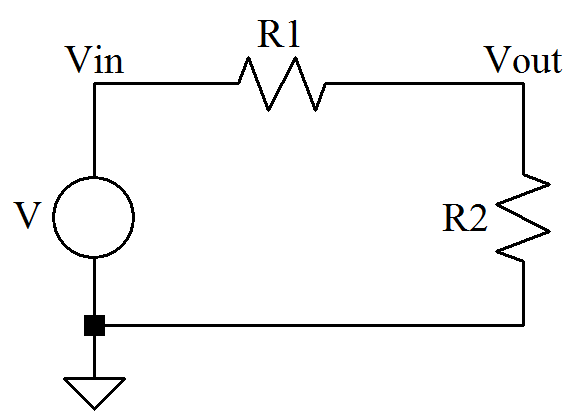
The transfer function of this network is:
![\[\mathcal{T} \; = \; \frac{\, V_{out} \, }{V_{in}} \; = \; \frac{R_2}{\, R_1 \, + \, R_2 \, }\]](https://davemcglone.com/wp-content/ql-cache/quicklatex.com-76cb4e9f378f761b57ec8a907665ec29_l3.png "Rendered by QuickLaTeX.com")
The sensitivity of this function to changes in R is:
is:
![\[S_{R_1}^{\mathcal{T}} \; = \; -\frac{R_1}{\, R_1 \, + \, R_2 \, }\]](https://davemcglone.com/wp-content/ql-cache/quicklatex.com-b8e856dbb39771a536d1271f83015726_l3.png "Rendered by QuickLaTeX.com")
and for R :
:
![\[S_{R_2}^{\mathcal{T}} \; = \; \frac{R_1}{\, R_1 \, + \, R_2 \, }\]](https://davemcglone.com/wp-content/ql-cache/quicklatex.com-d5b9608427fb4ce77a506e17ebee4275_l3.png "Rendered by QuickLaTeX.com")
The sensitivities are identical except for the sign. The sensitivity of  to changes in R is negative: if R increases, the value of decreases. However, the value of increases if R increases. If the two resistors are equal, the sensitivity is 0.5. This implies that a 1% change in either resistor will result in a 0.5% change in .
In the limit, if R >> R, the sensitivity of to changes in resistance tends to a value of 1; a 1% change in either resistor causes a 1% change in . If R >> R, the sensitivity of to changes in resistance tends to a value of 0; the function is essentially independent of changes in resistance.
The most common variations in resistances are tolerance and temperature. Other possibly significant variations are voltage and load/life effects. Some applications will also require radiation tolerances … but those applications are quite specific – if you need them, you’ll know where and how to get them.
Voltage and aging coefficients are often ignored (and may not even be specified) but may have a significant effect in precision applications.
Some specifications for a precision resistor:
Tolerance: ±100 ppm (0.01%)
Temperature coefficient: ±0.2 ppm/C (-55°C to 125°C)
Power coefficient (self-heating): 5 ppm
voltage coefficient: < 0.1 ppm/V
load/life stability: 50 ppm (after 2000 hrs)
ESD: > 25 kV
thermal stabilization: ±10 ppm
rise time: 1 ns
Inductance: < 0.08 μH
A proper sensitivity analysis for a precision application will take each of these factors into consideration. The analysis of that simple resistor divider is no longer “simple” …
The same principles apply to reactive components and construction techniques as well (for example, flexing of a PCB can change the operational accuracy of a circuit. Many components will have flexibility criteria.)

That’s good for now.